Sunday, May 31, 2009

Home Again, Home Again, Jiggity Jig

Two weeks of travel -- visiting our kids, our kids-in-law and our brandy-new grandkid. One week of trying valiantly to get caught up with the pile of bills, jungle of weeds, and various and sundry things-that-need-to-be-done! A huge thanks to my brother-in-law who kept the house, the garden, the cat and the Mother happy while we traipsed around the country. It's good to be home!

The garden is thriving!! The potatoes are threatening to smother everything in their path and the 'bush' cucumber is vining all over the place, but all is well and very happy. It does look like the straw bale plants need more watering now that the weather is getting hotter, and could probably do with regular doses of compost tea. I'll get right on that . . . Also noticing a big difference in the two eggplant plants. One got a mix of amendments (blood meal, bone meal, epsom salts and kelp meal) while the other got inoculated with mycelium. The amendment plant is winning by much more than a nose. (Actually, it's winning by three or four eggplants). I'm going to try feeding number two the same mix as number one and see if it can catch up.


My potatoes (darker green)have overwhelmed the pepper plants (lighter green)!! Peppers and tomatoes are looking a little anemic anyway. They seem to be hungry . . . nothing a regular diet of compost tea won't cure (I hope!)


And as for the weekly roundup:
1. Plant something – I planted some cannas in the front bed. Not edible, but pretty!
2. Harvest something – We harvested a handful of grape tomatoes. several peppers of different varieties, and a few radishes -- those that didn't get too woody in our absence. The woody ones have been left to go to seed.
3. Preserve something – Umm, not yet.
4. Reduce waste – Added more bottles to my 'drunkard's path.'
5. Preparation and Storage - Made more yogurt. Bought the following books (on sale at Mother Earth News):
The Contrary Farmer by Gene Logsdon
The Contrary Farmer's Invitation to Gardening by Gene Logsdon
Growing Gourmet and Medicinal Mushrooms by Paul Stamets
From the Cook's Garden by Ellen Ecker Ogden
Read Depletion and Abundance by Sharon Astyk (Highly recommended. Review to come one of these days!)
6. Build Community Food Systems – I bragged about how well my garden is doing, does that count?
7. Eat the Food - It all went in salads or yummy chicken fajitas.

That's it for this week. Next week should be a bit more productive!

Monday, May 4, 2009

Challenge Week One

1. Plant something – replanted chard and okra to compensate for a less than stellar germination rate. I also planted three flower boxes with a mixture of leaf lettuces and rocket (arugula).

2. Harvest something – harvested a couple of bell peppers from a bush that overwintered on my back porch and some radishes.

3. Preserve something - Not this week. Florida has such a long growing season that fresh food is available year round – if not from the garden, at least from the wild. Preserving is not a biggie on my list – but it would be nice to learn a few tricks in case I ever need them.

4. Reduce waste – Composting with and without worms. Worms look happy so far as I can tell. Recycling what I can. Reusing wine bottles to make a border for the beds along my walk -- better known in quilting circles as drunkard’s path! Making my own yogurt in reuseable glass jars.

5. Preparation and Storage -- Baked bread using the method described in Artisan Bread in Five Minutes a Day by Jeff Hertzberg and Zoe Francois and made yogurt. Finished reading Toolbox for Sustainable City Living by Scott Kellogg and Stacy Pettigrew. While the book does not go into enough detail to be a true ‘how-to’ book, it does introduce a whole panoply of possibilities for what can be done in an urban (suburban, or even rural) setting. Topics covered are: food, water, waste, energy, and bioremediation. Ordered Depletion and Abundance by Sharon Astyk. Started an emergency pantry and began stocking with beans, rice, dried fruit and canned goods. Here on my sandbar in the Gulf of Mexico, our most likely emergency would be a hurricane – in which case the pantry might be gone with the wind. Hence, I’m building an emergency supply but in very limited amounts.

6. Build Community Food Systems – Gave a loaf of homemade bread to a neighbor and took another neighbor on a tour of my garden.

7. Eat the Food – The radishes and peppers went into a salad; bread and yogurt don’t last long in our house.

Friday, May 1, 2009

Looking Good in the 'Hood

This past week, I carefully dug up my potatoes (which had already sent up shoots), dumped out the barrel, and replanted with better drainage (crushed cans in the bottom, sand and ironite mixed with the soil and manure). And they survived!! They even look happy! I was afraid they would rebel at the second planting but I figured it was either that or let them drown. Looks like I definitely made the right choice.

I also planted my flower boxes with a mixture of leaf lettuces and rocket (arugula), replanted some okra and chard that failed to make an appearance, and inoculated much of my garden with mycorrhizal fungi. (After watching the video Six Ways Mushrooms Can Save the World,
I was so intrigued that I ordered the book Mycelium Running and the supplement MycoGrow™ For Vegetables. I purposely left some plants uninoculated as a control group. Stay tuned.)

So far, everything is looking goood. The peppers are peppering, the tomatoes, eggplant and squash are blooming, and everything is coming up roses, er, vegetables. Let’s hope the good results continue once we get into the hot hot season. . . .

Up for the Challenge?

Sharon Astyk has issued her Independence Days Challenge and I’m a sucker for a challenge. I’ve decided to post my updates here on my blog – gets me blogging on a more regular basis (ahem) – and allows me some expansion room. The idea is to keep track of our successes, however small, and to quit beating ourselves up for not doing everything at once. Just what I need! So the challenge is to do the following and report back once a week:

1. Plant something - I doubt this one needs a lot of explanation. Obviously, those of us in the Northern Hemisphere are doing a lot of this right now, but it should be a reminder that gardening isn’t “put in the garden on memorial day and that’s it” - most of us can grow over a longer season than we do, and even if you live in an apartment, you can sprout seeds. So keep on planting!

2. Harvest something - some people are full swing here, but even if you just picked the first dandelion from your yard, it counts if you ate it or saved it. Don’t forget to include food you forage - whether from wild marginal areas, or even just from the neighbor’s trees that he never harvests (ask, obviously).

3. Preserve something - this starts around now for me, as asparagus, nettles and rhubarb are up. Canning looks like a big scary project if you have to can a truckload of green beans on a hot day in July. Dehydrating seems overwhelming if you have to pick the pits out of 4 bushels of plums in a single afternoon when you’d rather be doing something else. And yes, sometimes everything comes ripe at once, some big jobs can’t be avoided, and you just put on the loud rock and roll and go at it. But a little at a time is possible, you can be canning corn relish while you are washing up from dinner, or stick the strawberries in the sun to dry on your way out the door.

4. Reduce waste - This category covers both the old “Reduce Waste” and “Manage Reserves” group. Once you’ve got food, whether purchased or home preserved, you have to keep an eye on it. In this category goes making sure you use what you buy or grow, cutting down on garbage production by minimizing packaging and purchasing, composting, reducing community waste by composting or feeding scraps to your animals, and taking care of your food storage - everything from keeping records and writing dates on jars to checking the apples and making sauce when they start getting soft. BTW, reduce waste also refers to money and energy - stretching out your trips to the store and not “spending” gas on your food, cutting your grocery budget and reducing cooking energy.

5. Preparation and Storage - This is the category where you report the stuff you’ve done to get ready that isn’t growing/storing/preserving food. That means the food you buy for storage, the things you build, scavenge, rescue and repair that get you further down the path. Did you get a good deal at goodwill? Scavenge some cinder blocks for your raised bed building project? Find a grain mill on Craigslist? Buy some more rice and put it away? Inventory the medicine cabinet? Pick up a new book that will be helpful? Tell us!

6. Build Community Food Systems - Great, we’re all doing this stuff at home. But what did you do to help spread the message, because that may even be more important. Did you talk about your victory garden at your kid’s school? Offer to share space with a neighbor in your sunny yard? Bring a casserole over to the family that lost their job or moved in? Donate to your food pantry? Teach the neighbor kids to make yogurt? Offer to teach a canning class? Show someone else where the nettles are growing wild? Talk about your food storage or gardening plans? Share a plant division or seeds?

7. Eat the Food - Sometimes I think people have more trouble actually eating their garden produce or CSA shares than they do growing or buying them. Ultimately, eaters have more power over our agricultural future than they know - farmers can’t necessarily lead the way - they have to sell what eaters want. So cooking and eating are the way we will change the food system. This is where you tell us about the new recipes you tried, or the old ones you adapted to new ingredients, about how you are actually eating what you store and store what you eat, or getting your kids to try the kale.


So that’s the challenge. We’ll see if I’m up to it!!

Monday, April 20, 2009

How to Drown Your Potatoes in One Easy Step


I have been busy gardening even if I haven’t been busy blogging about it! I’ve gotten my straw bales planted with five peppers, three tomatoes, one cucumber, one watermelon and some nasturtiums for added interest. To plant the peppers and tomatoes, I dug a hole in the straw twice as wide and twice as deep as the containers they came in. Well, ‘dug’ is a misnomer. I used a trowel to loosen the straw and then pulled it out by handfuls until I had a hole the size I wanted. It was slow, tedious work. Then I filled the holes with a 50-50 mix of topsoil and composted cow manure, sprinkled with a bit of soil inoculant. I used the straw I ‘dug’ out of the bales as mulch on my lasagna beds, so that was a bonus. I did notice that the bales are already showing signs of breaking down – I’m hoping they’ll last this season and almost certain they won’t last for a second. In all truth, it seems like doing things the hard way – sticking the plants in the ground would have been easier. But I didn’t have a suitable piece of ground to use, so the straw bales are serving a purpose. Once the bales were planted, I topped them with a soaker hose strung through some tile bricks I had lying around. The hose goes under the stairs, where the shade preferring potatoes and horseradish are planted, then winds its way through the lasagna beds – good system if I do say so myself. I may go with a timer for the hose eventually, but for now I can turn it on manually, walk way, and come back with the plants have had enough. Only I have to remember to come back, which I didn’t last time – hours later, I heard the water running and figured out why . . . .


On other fronts, I finished planting my third lasagna bed – ginger (which I ordered from Gurney’s – paid quite a bit for a tiny sliver – won’t do that again), a banana tree which came from a plant I just divided, and peanuts. I also planted my potato barrel. Hmmm.

Okay, the potato barrel. The idea is super: plant potatoes in a barrel and as they grow, add more soil --which increases the yield. When the season is over, dump out the barrel and pick up the liberated spuds – no digging, no potential for damaging the tater skins. Sounded great, so I bought a very suitable container at Wal-mart, had my husband drill the bottom with as many holes as possible, then mixed equal parts of peat moss, soil and compost as a planting medium. The potatoes (purchased from Burpee’s for more than I should have paid) had been languishing in their plastic baggie for way too long. When I bought them, I didn’t realize three things – one is that they are a cool weather plant, two, that the planting season in Florida ends in March, and three, that I wouldn’t find time to plant them for a while. One of the potatoes had already started to rot and the others were sprouting, but, hey, this is an experimental garden, right? It’s not so much about growing potatoes as it is about learning from my experience, mistakes and all. So the potatoes got planted and then I watered. Guess what? The water didn’t drain . . . well, it did, but very, very slowly. I’ve let the potato barrel dry somewhat and I’m going to dump it out and start over. I may kill my little sprouts in the process, but I’m almost certain that if I leave as is they will drown in our next big rainfall. When I redo, I’m going to crush some tin cans and put them in the bottom to improve drainage (oops, meant to do that the first time and forgot), then I’m going to mix some of our sand into the planting mix. Our sand is quite alkaline and potatoes like acid soil, so I’ll throw in some ironite to balance the PH. Then we’ll see how they do.

In the meantime, I’ve been reading, reading, reading. I’ve ordered a slew of books and getting ready to order more. As I have time, I’ll try to provide some book reviews. LOTS of fantabulous information out there! So much to learn, so little time!!

Monday, March 30, 2009

Bird, Watching

I am finally making some progress! I now have two ‘lasagna’ beds finished and planted. In addition to the layers of newspaper, peat moss, compost, organic matter (mostly weeds) and topsoil that went onto my new beds, I sprinkled on bone meal, blood meal, kelp meal and soil activator (with microbes that are supposed to help bring the soil to life). These were raked into the top layer. I may add ironite if new growth isn’t as green as it should be. All the amendments had suggestions for rate of application – so many pounds per so many square feet. I can never figure that out – so I sprinkle and hope for the best.

Yesterday being a good day for planting ‘above ground annuals,’* I planted amaranth, cucumber, two varieties of squash, eggplant, nasturtiums, swiss chard and okra. I also planted a variety of herbs, some of which are perennial . . . so I cheated just a bit. Just recently, I read in Mother Earth News that swiss chard does not like full sun and, of course, the bed for it was in the full sun, so I inter-planted the chard with okra in hopes that the taller plants will shade the shorter ones. I had soaked the chard seeds overnight and ended up with more than I needed, so I tossed the extras under a shady tree. Maybe I’ll get something, maybe I won’t. I also realized, after-the-fact, that I had violated the rules of companion planting by putting cucumbers and herbs in the same bed. Well, I don’t have many options at present, so we’ll see how it goes. There should be room in one of the straw bales for another cucumber, so I can compare results. Sort of. I don’t know that comparing a plant in a straw bale to a plant in a lasagna bed is exactly scientific, but it’s an experiment all the same.

When it came to labeling, I had read that one could use plastic knives as labels. I didn’t have any plastic knives, but I did have plastic spoons. So I wrote on the spoon handles with a permanent marking pen and stuck them in the ground in front of the seeds. The labels will likely be illegible by the end of the season, but by then, I shouldn’t need them anymore anyway.


Now I need to keep it all watered until the seeds sprout. Rain is forecast for tomorrow and the next day, so Mother Nature may help me out. Once the plants are up, I intend to snake a soaker hose through the garden and put it on a timer – that will not only save me a lot of work but will keep the garden watered when I go to visit my kids in a month or so. The beds are not all contiguous, so this should get interesting! I will also need to mulch. I’m not sure what to use. In my flower beds, I use pine bark nuggets, but those are awfully coarse for a vegetable garden. Cypress mulch is an environmental no-no, straw is not readily available, compost tends to crust over, and we don’t have a lawn to provide clippings. I think I may use weeds – young, seedless weeds.

In our yard, we have three categories of weeds. There are weeds I like. I call those ‘wildflowers.’ There are weeds we can eat. I call those ‘salad.’ And there are weeds that I don’t like or are growing where they shouldn’t. I call those ‘weeds.’ The neighbors don’t seem to understand my classification system, but they tolerate my eccentricities anyway! I have an abundance of all three categories of weeds, so finding mulch shouldn’t be too onerous.

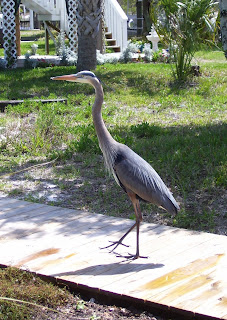
So why did I title this post "Bird, Watching"? Because today when I watered the garden, there was a bird, watching. 'Charlie,' as we call our blue herons, waited until I had finished and went in for a closer look. I don't think he's seen a lasagna garden before!


Charlie

checks

it out!!


*according to my moon calendar

Saturday, March 28, 2009

Online Education

I love, love, love the internet! I learn 100 new things every time I log on, and that’s in just the first ten minutes! Okay, slight exaggeration, but I do learn tons . . . better and cheaper than a college education!

One of the things I learned about is straw bale gardening. Straw bale gardening is not suitable for root crops, but for just about anything else – including tomatoes and peppers, which are what I’m planting in mine this year. You start with wheat straw bales tied with synthetic twine, if you can find them. Place the bales with the ties horizontal to the ground in whatever spot you plan to use them (can even be on a balcony, driveway, or other hard surface), and keep them watered for 7-10 days to prime them for planting. During the saturation stage, the wheat supposedly heats up and then cools off. Once they are cool, they are ready to plant. Rough up the top three inches of straw and work in compost, soil -- whatever you plan to plant in. Then plant and water as usual.

I’m using this method for several reasons – one is that I can plant under an existing pergola, giving my tomatoes and peppers dappled sun. I’ve found that full sun can be too intense in this area. The second reason is that tomatoes should not be planted in the same place each year – otherwise diseases build up in the soil. If you have a small garden, as I do, it’s not easy to find new places to put the tomatoes. And lastly, I just want to try it and see how it works. Last year, I tried planting my one tomato upside-down in one of those baggie things, and that was a disaster. Our strong winds whipped the plant around and broke off major branches. Then the winds turned really salty as Gustav and Ike passed through the Gulf. What was left of the tomato plant turned brown and crispy. This year’s crop will be in a more protected spot, and I’ll keep my fingers crossed.

So the first step is to find straw bales. I was looking in garden centers. Not the place to look. At least around here, you have to look in feed stores or saddleries. I figured I needed four bales and hoped they would fit in the back of my Toyota Highlander. They did, but just barely. I had put a blanket down to protect the interior of the car, but I still had a lot of cleaning to do after I pulled the bales out. The little things they never tell you! I put my bales in place and it has been raining ever since. We have a couple of clear days in the forecast and then more rain, so keeping them wet could not be easier! In the meantime, my tomatoes and peppers have arrived and I have them acclimating on the screened porch.

With all the rain, I’ve been spending more time on the internet learning more wonderful things. Yesterday, I learned about chia seeds. It seems that chia seeds have more omega three’s than flax seeds, don’t have to be ground the way flax does, and are easier to store. Plus they are packed with protein, calcium, anti-oxidants and other wonderful stuff. They supposedly have a pleasant, nutty flavor and can be added to almost anything. If put in water, they turn into gel – which makes me wonder if they could be used to for a Jell-O substitute or added to stewed fruit to make jelly. They can be sprouted and eaten that way, or grown and harvested as young greens (remember chia pets?) I’m not sure how easy they are to grow to maturity – but why not try and find out? I found several sources for the seeds on the internet, but shipping and handling was mucho expensivo, so I’m going to look in our local health food store first.

More tidbits from yesterday’s surfing: Rocket and collard flowers are supposedly delicious! If you live in a warm area like mine, the season for greens like arugula (also known as rocket), lettuce, spinach, cilantro and other cool weather greens is decidedly short. Everything wants to bolt – wherein the leaves turn tough and bitter and flower stalks shoot toward the sky. Of course, the plant doesn’t know it’s supposed to stay a tender, young baby, it just wants to get on with reproduction. But now I know I can eat the flowers if not the leaves, at least of the rocket plants. And cilantro, once it goes to seed, is known as coriander – another second use for a versatile plant. But I am also going to try growing cilantro and arugula indoors this summer, another experiment. Will they last longer in an air-conditioned house? (We keep our thermostat at 80 so it’s not exactly cool . . . but cooler than out-of-doors).

And lastly, I ran across an amazing video yesterday -- A Farm for the Future. This is a long one, fifty-some minutes, but well worth the time it takes to watch. Rather sobbering, really.

Well, another rainy day on my little island. Wonder what I'll learn today?